
How to Build with Insulated Concrete Formwork (ICF) in Ireland (2026 Homeowner Guide)
Everything you need to know before pouring concrete. Discover how ICF combines structural steel-reinforced concrete with continuous permanent insulation for stronger, warmer, quieter Irish homes.
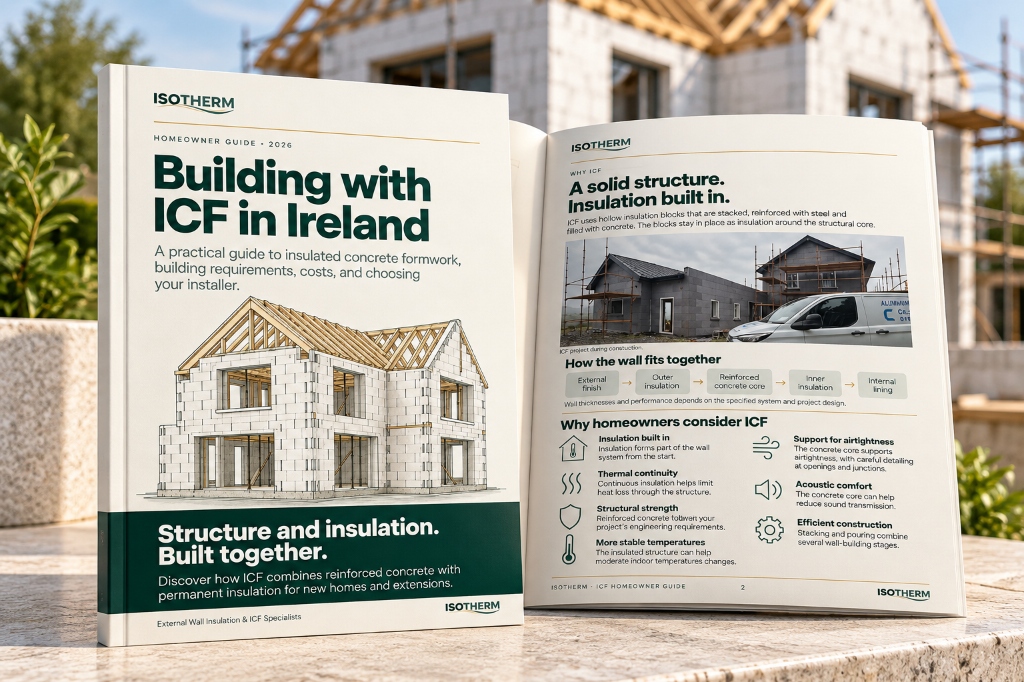
Where Should We Send Your ICF Guide?
No credit card required. Receive your instant PDF guide download.
What You’ll Learn Inside the Free 2026 ICF Guide
Clear, practical advice written by Irish construction engineers who install and inspect ICF structures daily.
How ICF Works & Key Systems
Hollow EPS/Neopor blocks stacked, reinforced with steel rebar, and filled with poured concrete. Learn the anatomy of an airtight Irish home.
2026 Build Cost Benchmarks
Real per-m² price comparisons between ICF, twin-leaf concrete blocks, and timber frame in the current Irish construction market.
Thermal Continuity & U-Values
Achieving U-values of 0.15 W/m²K or better without external cold bridges, thermal bypass, or cavity wall draughts.
Airtightness & Acoustic Comfort
Monolithic concrete core provides unmatched sound attenuation from busy roads, gale-force storm protection, and sub-1.0 air changes/hour.
Window Reveal & Cill Details
How to seal window reveals correctly with bespoke aluminium cills to prevent moisture ingress and thermal short-circuits.
5 Questions for ICF Installers
Crucial checks on concrete pour rates, bracing alignment, BCMS certification, and engineering sign-off before signing a contract.
Building with ICF vs Traditional Cavity Block
Why leading Irish architects and self-builders are switching to Insulated Concrete Formwork.
Trusted by Hundreds of Irish Self-Builders
“Building our own home was daunting until we downloaded the Isotherm ICF guide. It gave us the exact cost per m² benchmarks and saved us from choosing an uncertified installer. Our home reached A1 BER with zero draughts.”
“Clear, concise, and no marketing fluff. The chapter on window reveal details and thermal bridging alone saved our engineer days of back-and-forth. Essential reading for anyone building in Ireland.”
“We were torn between timber frame and ICF for our two-storey extension. This guide laid out the true costs and acoustic benefits clearly. Our extension stayed warm throughout the coldest winter weeks.”
Frequently Asked Questions
Common questions from homeowners and self-builders exploring ICF.
Is this ICF guide really 100% free?
Yes, completely free. You will get instant access to download the high-resolution PDF on this page, and a permanent copy will also be delivered to your inbox for future reference.
Is ICF more expensive than traditional blockwork in Ireland?
While ICF material costs are slightly higher, the speed of construction, reduced scaffolding time, built-in insulation, and elimination of secondary drylining often balance the total build cost. Our guide breaks down exact 2026 pricing figures.
Does building with ICF meet Irish Building Regulations (Part L)?
Yes. ICF construction easily achieves Part L nZEB compliance with typical wall U-values ranging from 0.18 down to 0.11 W/m²K, which effortlessly meets or exceeds Irish standards.
Can ICF be used for home extensions as well as new builds?
Yes! ICF is popular for modern extensions because it can be poured quickly in tight spaces and ties cleanly into existing masonry structures.
Ready to Build a Stronger, Warmer Home?
Download your free guide today, or get in touch with our team for an initial architectural review and fixed-price ICF estimate.