

Loading Isotherm Ireland...
External Wall Insulation & ICF Specialists
Loading Isotherm Ireland...
External Wall Insulation & ICF Specialists
A technical homeowner guide to premium internal plastering, drylining, coving ceilings, and external wall finishes across blockwork, EWI, and ICF.
The finishes on your home do far more than define its visual aesthetic. Whether it is internal plastering or external rendering, these layers act as the functional protective skin of the building. The choices you make will impact your home's moisture control, breathability, durability, and resistance to thermal cracking.
From installing premium plasterboards and applying a glass-smooth skim coat plaster, to executing specialized lime plaster applications for historic restorations or choosing flexible silicone finishes for insulated concrete forms (ICF), this guide breaks down the core technical considerations to help you achieve a high-performance finish.
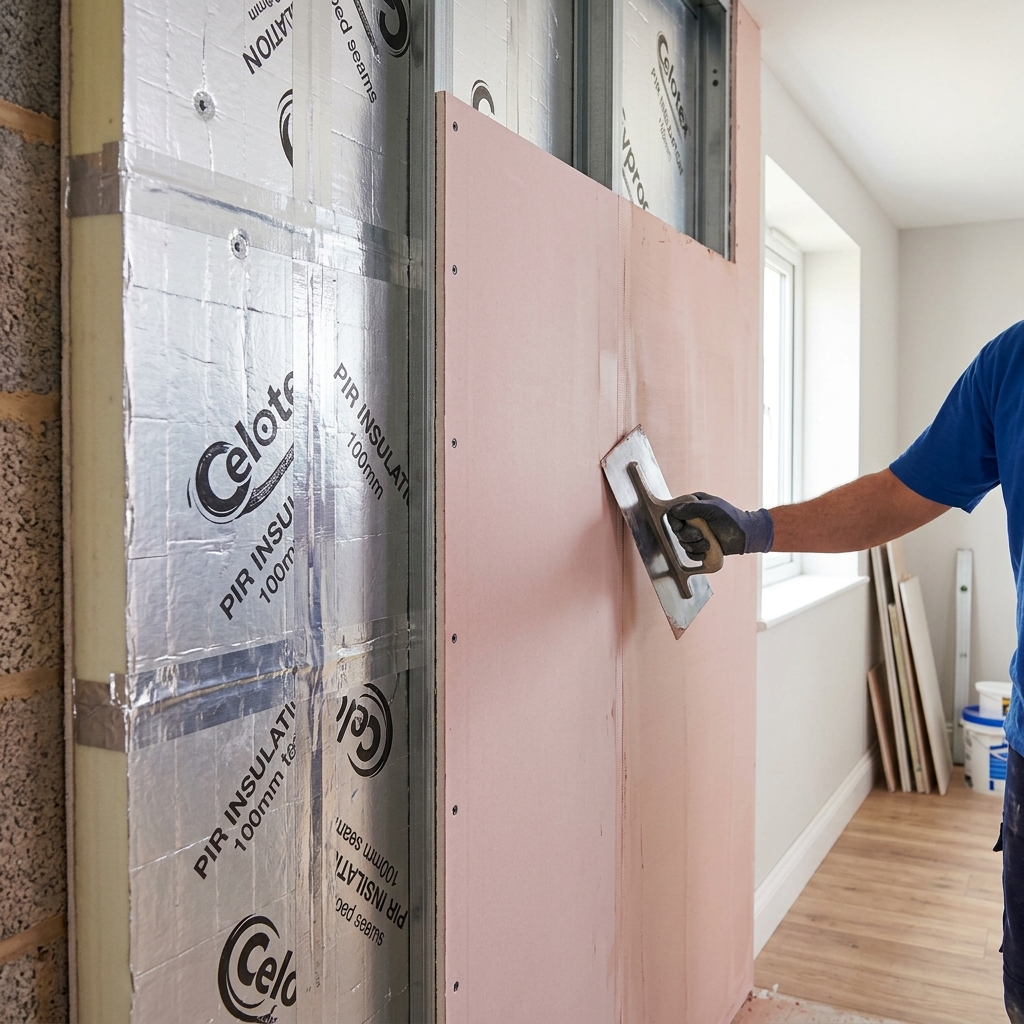
A rendering system is only as good as the substrate underneath. Renders must match the flexibility and breathability profile of the structural wall. Below is a breakdown of requirements across the three primary wall types in Ireland:
Irish masonry is built with dense concrete blockwork. Because these structures are highly rigid and have massive thermal capacity, traditional sand and cement renders (exterior) and hardwall/gypsum plaster (interior) are commonly used. However, blockwork is subject to minor settlement and thermal changes, making rigid renders prone to hairline cracks. Selecting a through-coloured monocouche render can mitigate cracking while eliminating the need for periodic painting.
When retrofitting external insulation, insulation boards (typically EPS) are fixed directly to the exterior walls. Because EPS boards are semi-flexible and expand/contract under intense sunlight, **traditional rigid renders must never be applied**. A heavy sand/cement render will shear and detach. EWI systems require a lightweight, flexible, polymer-modified basecoat with an embedded fiberglass mesh layer to distribute thermal stress, finished with a thin-coat, self-cleaning **silicone render** or **acrylic render**.
ICF structures present an Expanded Polystyrene (EPS) face both internally and externally. Externally, ICF is treated identically to EWI: it requires a mesh-reinforced basecoat and a flexible, breathable silicone or acrylic thin-coat render to absorb thermal movement. Internally, homeowners can choose to mechanically screw plasterboard panels directly to the embedded plastic ties in the ICF blocks before skimming, or apply a specialist plaster coat using reinforcement mesh directly onto the internal EPS foam.
When finalizing the interior of your build or renovation, the choice of plastering system determines the wall's longevity, aesthetic quality, and moisture management:
A standard **skim coat plaster** refers to the application of a thin (typically 2-3mm) layer of gypsum finish plaster onto **plasterboards** (drylining) or a cement undercoat. It requires exceptional trowel work to achieve a high-gloss, glass-smooth texture. Skimming creates a seamless, uniform substrate that is ideal for modern emulsioned walls.
Unlike gypsum, **lime plaster** is highly vapor-permeable and flexible. Traditional solid stone houses in Ireland (built pre-1940s) do not contain wall cavities and must breathe. If gypsum or cement is applied to these historic walls, water is trapped, causing rising damp, rotting timbers, and peeling paint. Lime plaster absorbs indoor humidity and releases it to the atmosphere, preventing condensation and preserving the structural envelope.
For a luxury finish, **venetian plaster** blends slaked lime and crushed marble dust. Applied by hand in ultra-thin, overlapping layers using specialized spatulas, it is burnished to create a multi-dimensional, marble-like, reflective finish. It is highly valued for feature walls, fireplaces, and wet-room ceilings due to its natural breathability and mold-resistant qualities.
Plaster coving (cornices) runs along the ceiling-wall junction. Beyond the architectural transition it provides for **coving ceiling** designs, plaster coving has a structural benefit: it masks natural shrinkage cracks that frequently appear between timber ceiling joists and brick or stud walls as the building settles.
External renders must protect structural blockwork from rain penetration while providing an attractive facade. Modern systems offer low-maintenance alternatives to traditional wet-trade renders:

Use the comparative table below to understand the application limits, breathability, and typical thicknesses of the different finishes:
| Finish Type | Main Substrates | Thickness | Breathability | Flexibility | Est. Cost (m²) |
|---|---|---|---|---|---|
| Gypsum Skim Coat | Plasterboard, Hardwall | 2 - 3 mm | Low | Low | €15 - €25 |
| Lime Plaster | Historic Stone/Brick | 15 - 20 mm | High | Medium | €45 - €70 |
| Venetian Plaster | Skimmed Walls, Drylining | 1 - 2 mm | Medium | Low | €90 - €150+ |
| Sand & Cement Render | Blockwork, Brick | 15 - 20 mm | Low | Low | €35 - €50 |
| Monocouche Render | Standard Blockwork | 15 - 18 mm | Medium | Low | €55 - €70 |
| Silicone Thin-Coat | EWI, ICF, Blockwork | 1.5 - 3 mm | High | High | €60 - €85* |
* Note: Silicone thin-coat estimate reflects materials and installation of mesh basecoat & render finish (excludes primary insulation boards). Costs are approximate and fluctuate based on project scale and regional access.
Because correct external rendering is vital to ensure structural weatherproofing, you should always choose a fully registered, vetted professional. Below are certified contractors available for your EWI, ICF, and traditional rendering projects:
Loading Official Isotherm Quotation...
Preparing certified Baumit & NSAI specifications
Get free, no-obligation quotes from vetted external rendering and internal plastering specialists in your county.
Request Vetted Quotes